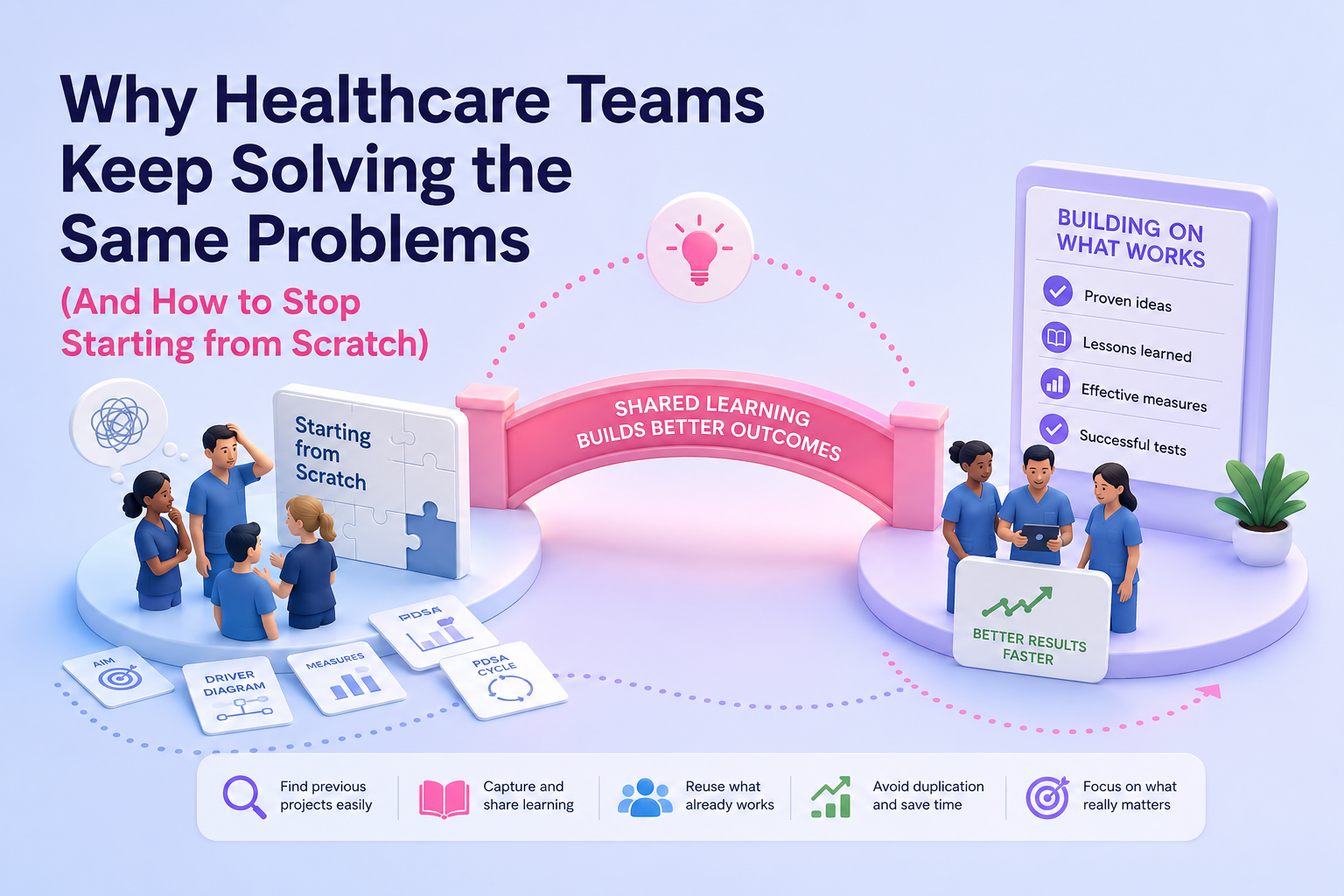
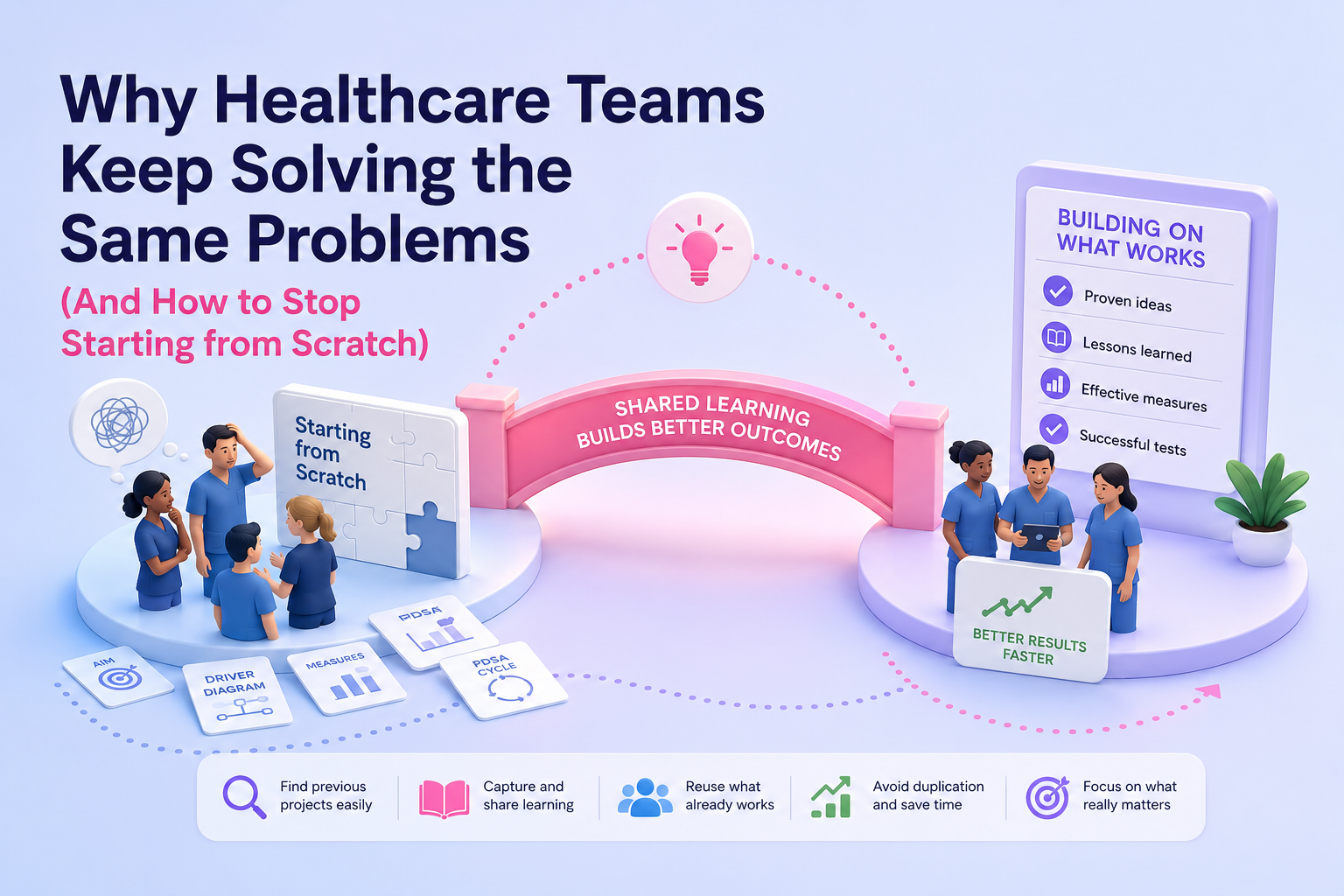
Healthcare organisations are constantly improving.
Every day, teams across hospitals and health systems launch projects to reduce patient falls, improve patient flow, shorten waiting times, strengthen infection prevention, improve staff experience and deliver safer care. Each of those projects generates valuable knowledge. Teams discover which interventions work, which don't, what barriers they encounter, and how they overcome them.
Yet despite all of that learning, it's surprisingly common for another team elsewhere in the organisation to begin tackling exactly the same problem... almost from scratch.
They create a new project.
They debate the same root causes.
They test many of the same ideas.
They repeat many of the same mistakes.
Not because anyone is unwilling to share what they've learned, but because improvement knowledge is often difficult to find, scattered across different systems, or simply lost over time.
The result is that organisations spend enormous amounts of time rediscovering knowledge they already possess.
Healthcare doesn't have an ideas problem. It has a knowledge reuse problem.
Healthcare Creates More Improvement Knowledge Than Ever Before
Every improvement project creates far more than its final outcome.
Along the way, teams build a rich understanding of the problem they're trying to solve. They identify contributing factors, engage stakeholders, collect data, test changes, adapt their approach and learn from both successes and setbacks.
By the time a project finishes, it has usually generated valuable assets that could help other teams facing similar challenges, including:
- Driver diagrams
- Process maps
- Measurement plans
- PDSA cycles
- Stakeholder engagement approaches
- Risk assessments
- Lessons learned
- Practical implementation tips
Unfortunately, these assets often remain within the project team that created them. When another team decides to tackle a similar challenge six months later, they may have no idea that this knowledge already exists.
Why Teams End Up Starting From Scratch
Most organisations don't intentionally duplicate improvement work. It happens because valuable knowledge becomes increasingly difficult to discover over time.
Improvement knowledge lives in too many places
Project information often ends up spread across emails, shared drives, spreadsheets, presentation slides, meeting notes and personal documents. Even when everything has been documented, finding the right information at the right time can be surprisingly difficult.
People move on
Healthcare is dynamic. Staff rotate between departments, improvement advisors take on new roles, and experienced clinicians retire or move elsewhere. When knowledge exists primarily in people's heads, organisations lose valuable experience every time someone leaves.
Previous projects are difficult to find
Perhaps another team has already reduced falls on an orthopaedic ward or improved discharge processes in the emergency department. Unless that work is visible and searchable, other teams may never know it happened.
Learning isn't captured consistently
Many projects do an excellent job of recording what they achieved. Fewer document how they achieved it. The practical lessons: what surprised the team, which ideas failed, what they would do differently next time—are often the most valuable information for future teams.
The Hidden Cost of Reinventing Improvement
Starting from scratch doesn't just waste time. It slows organisational learning.
Progress happens more slowly
Every team spends valuable time rediscovering insights that already exist elsewhere in the organisation.
Instead of building on previous learning, they repeat much of the same exploratory work.
The same mistakes happen repeatedly
Many improvement challenges are remarkably consistent.
Stakeholder engagement, data collection, competing priorities and implementation barriers are experiences shared across countless projects. If lessons aren't passed on, each new team is likely to encounter many of the same obstacles.
Good ideas spread more slowly
Healthcare is full of innovative teams. But innovation only creates organisation-wide value when successful ideas can be adopted by others. When learning remains isolated within individual projects, proven approaches spread far more slowly than they could.
Improvement feels harder than it needs to
When every project starts with a blank page, improvement can feel overwhelming. In reality, many organisations already possess the experience needed to solve today's problems, they just struggle to make that experience accessible.
What Great Improvement Organisations Do Differently
The most effective improvement organisations don't simply deliver successful projects. They create systems that allow every project to strengthen the next one.
They make improvement work easy to discover
Teams can quickly find previous projects tackling similar problems. Rather than asking, "Has anyone looked at this before?", the answer is only a search away.
They capture learning alongside results
Successful organisations don't only record outcomes. They also document:
- What worked well
- What didn't work
- Unexpected challenges
- Decisions made
- Recommendations for future teams
This creates practical knowledge that others can build upon.
They encourage teams to adapt rather than reinvent
No two improvement projects are identical. But very few need to start with a completely blank page. Existing driver diagrams, measures, stakeholder plans and PDSA cycles often provide an excellent starting point that teams can adapt to their own context. Learn more about "What Does a Good Quality Improvement Project Look Like in Healthcare?"
They see improvement as cumulative
Every completed project leaves the organisation slightly stronger than before. Knowledge accumulates.
Confidence grows. Improvement capability increases over time. Instead of solving isolated problems, organisations steadily build a culture of continuous learning.
Five Practical Ways to Stop Starting From Scratch
1. Search before you start
Before launching a new project, ask: Has anyone else in our organisation tackled something similar?
Even if the context isn't identical, previous work may save weeks of planning and testing.
2. Capture learning, not just outcomes
Document more than the final results. Capture the decisions, assumptions, failed tests and unexpected discoveries that future teams will benefit from.
Read more on How to Run Better PDSA Cycles in Healthcare Improvement, where documenting learning is discussed in more depth.
3. Reuse proven approaches
Templates, driver diagrams, measures and project structures don't need to be recreated every time. Start with what already exists and adapt it to suit your local circumstances.
Learn more about Why Measurement Feels Hard in Healthcare Improvement — and How to Simplify It.
4. Make improvement work visible
Knowledge can't be reused if nobody knows it exists. Creating visibility across improvement work helps teams learn from each other instead of working in isolation.
5. Celebrate shared learning
A successful project doesn't just improve one service. Its greatest value may be helping ten other teams improve more quickly. When organisations recognise and reward knowledge sharing, continuous improvement becomes exactly that - continuous.
Turning Individual Projects Into Organisational Knowledge
Technology alone doesn't create a learning organisation. Culture, leadership and curiosity remain essential. But technology can make it dramatically easier to preserve, organise and share the knowledge that improvement teams generate every day.
Rather than allowing valuable learning to disappear into folders, emails or individual memories, organisations benefit from having a single place where projects, measures, PDSA cycles, discussions, decisions and lessons learned remain connected and easy to discover.
Life QI is designed to support exactly this approach. By bringing improvement work together in one shared environment, organisations can build a growing library of practical experience that teams can search, learn from and build upon. Instead of every project beginning with a blank page, teams can benefit from the knowledge already created by colleagues across the organisation.
Every Project Should Make the Next One Easier
Healthcare has never lacked people with good ideas. Nor has it lacked dedicated teams committed to improving care. The real opportunity lies in ensuring that every improvement project leaves something behind that others can use.
When organisations consistently capture and share what they've learned, improvement stops being a collection of isolated successes. Instead, it becomes an organisational capability that grows stronger with every project completed.
The next time your team begins planning an improvement project, ask one simple question: What has our organisation already learned that could help us get started?
The answer might save weeks of work, and help your team deliver better results, faster.